The company is growing, employees are busy all day, and the number of tasks keeps increasing, yet it feels as though the results are standing still. The manager sees the team’s activity but cannot answer a simple question: is the business actually moving toward its goals? This is the point when most companies start thinking about KPI.
What Is KPI in Simple Terms?
KPI is a system of measurable indicators used to assess whether an employee, department, or the entire company is achieving its goals. KPI stands for Key Performance Indicators. These are figures that show how successfully the business strategy is being implemented in a specific area.
In simple terms, key performance indicators are a benchmark that allows you to compare planned and actual results, see progress, and adjust actions in a timely manner.
Why Does a Company Need KPI?
First of all, KPI helps translate a company’s work and strategy into specific employee actions. Without clear criteria, managers rely on subjective impressions, while employees do not understand what is expected of them. KPI goals connect employees’ daily work with the company’s strategic priorities, while KPI tasks specify what needs to be done to achieve those goals.
Types of KPI: Main Categories of Performance Indicators
There is no universal set of KPIs. Performance indicators always depend on business goals, the specifics of the company, and employees’ areas of responsibility. The main criterion of a good KPI is that it should help determine whether the company is moving closer to the planned result.
Depending on the business objectives, the following types of KPI are most commonly used:
- strategic — assess the achievement of the company’s long-term goals;
- operational — help monitor the day-to-day work of departments;
- financial — reflect profit, expenses, profitability, and other economic indicators;
- customer-related — measure service quality, customer satisfaction, and loyalty;
- process-related — show the efficiency of internal business processes;
- HR KPI — help assess recruitment, onboarding, employee turnover, and engagement.
In practice, companies use several groups of indicators at the same time to obtain an objective picture of business performance and make data-driven decisions.
Employee KPI: Which Indicators Are Used to Evaluate Staff Performance
KPIs for an individual employee should be linked to their responsibilities and have an impact on the department’s results. Proper KPI setting means that each indicator is measurable, achievable, and clear to the employee. At the same time, every task should have a clear evaluation criterion. Usually, 3 to 5 indicators are selected — enough for an objective assessment without excessive reporting.
KPI Examples for Different Roles
Specific KPI examples vary depending on the employee’s function:
- sales manager — revenue, number of new customers, average order value;
- marketer — customer acquisition cost, website conversion rate, growth in target audience reach;
- support specialist — response time, number of resolved requests, customer rating;
- HR manager — time to fill a vacancy, employee turnover, staff engagement.
These KPI examples for employees show that every metric should reflect the area in which a particular role can genuinely influence company performance.
How to Develop KPI: A Step-by-Step Process
KPI development is a sequential process that requires attention at every stage:
- Step 1. Define business goals. Any KPI model should be built around the company’s strategic goals. At this stage, it is also important to assess which business processes affect the achievement of the defined goals and where the system will obtain the data needed to calculate the indicators. IT consulting helps analyze current processes, identify automation opportunities, and define requirements for digital tools used to monitor KPIs.
- Step 2. Select measurable indicators. Each indicator should have a unit of measurement and a defined method of data collection.
- Step 3. Set target values. They should be realistic while still encouraging growth, so that each task remains achievable.
- Step 4. Define the evaluation period. Monitoring can be monthly, quarterly, or annual, depending on the specifics of the business.
- Step 5. Set up monitoring and reporting. Without regular monitoring, even a well-designed Key Performance Indicators system loses its value.
How to Calculate KPI: Formulas and Calculation Examples
The basic KPI formula is simple and works for most indicators that can be expressed as a percentage of target achievement:
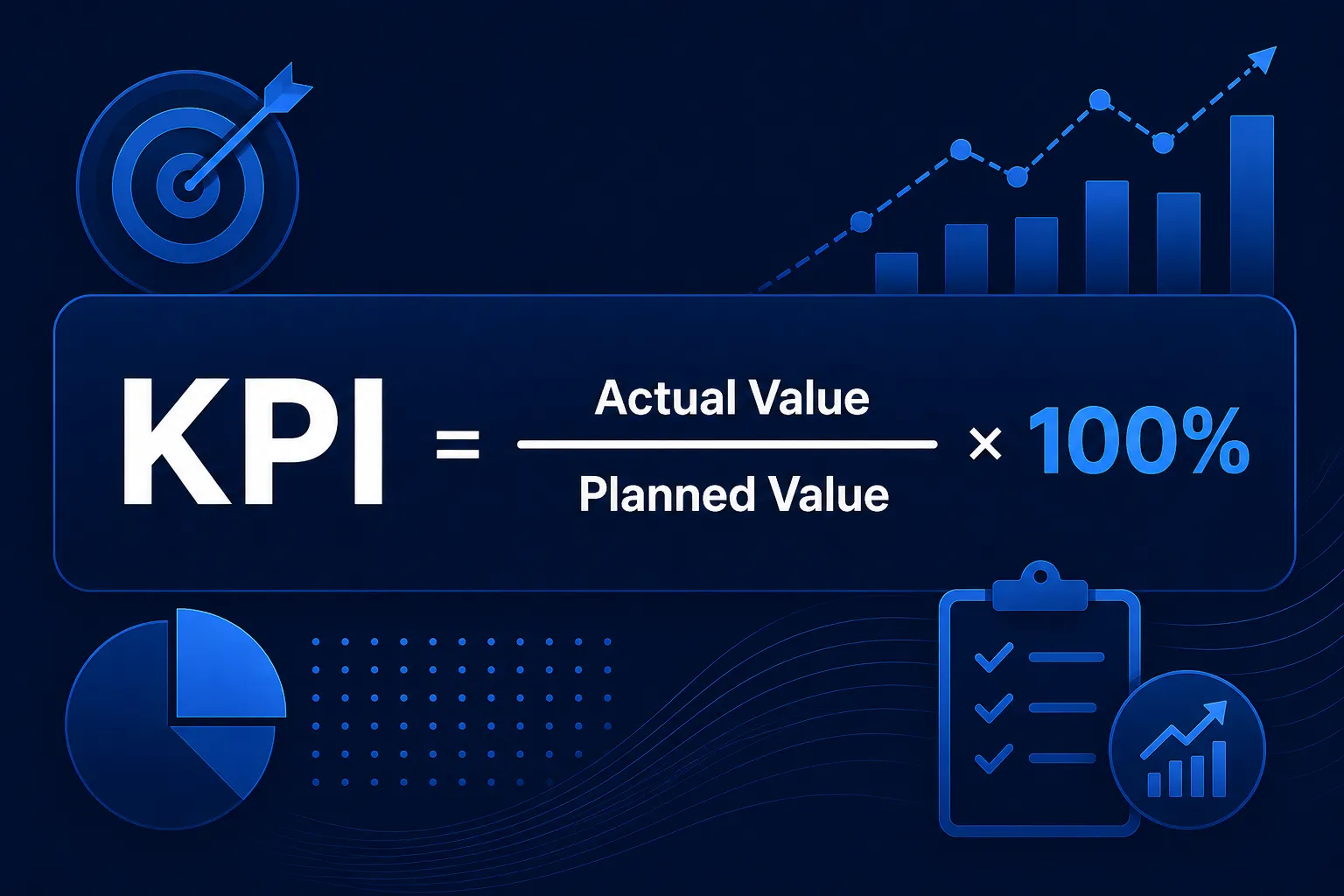
For example, if a sales manager’s monthly target was UAH 500,000 and actual sales amounted to UAH 450,000, the calculation would be: 450,000 / 500,000 × 100% = 90%. This means the target was achieved by 90%. Interpretation depends on the established thresholds: typically, 90–100% is considered a good result, below 80% is a reason to analyze the causes of underperformance, and exceeding 100% may be grounds for a bonus.
KPI Analysis: How to Use Indicators for Business Development
Numbers alone mean little without regular analysis. To assess the real effectiveness of KPI, several aspects should be considered:
- dynamics — changes in values over time show a trend rather than a one-off result;
- department comparison — helps identify best practices and underperforming teams;
- bottleneck identification — low results point to problem areas in processes;
- goal adjustment — target values should be revised in line with new market realities, since external factors also affect final results.
This approach turns Key Performance Indicators from a formal report into a key management tool.
A practical example: imagine a company where the head of sales evaluates employees only by sales volume. After a few months, sales increase, but profit declines. Managers have started selling products with the largest discounts in order to meet their KPI. The indicator itself was chosen incorrectly.
KPI System: Why Excel Is No Longer Enough
In many companies, performance is still tracked manually in spreadsheets. However, as a business grows, this approach becomes increasingly inefficient.
What Problems Arise When KPI Indicators Are Tracked Manually?
Manual data entry in Excel takes a lot of time, and any error can distort the result. Human error is one of the main problems because data may be entered late, lost, or duplicated. Metrics quickly become outdated because updates are performed irregularly.
How Does Automation Help Manage KPI?
KPI automation eliminates the limitations of manual tracking and reduces the time required to collect and process data. In particular, HR process automation makes it possible to consolidate employee data, performance evaluations, and key indicators within a single system. QS Integration builds a unified performance management system that includes:
- data collection from ERP, CRM, and HRM systems;
- a unified system of indicators for all departments;
- digital dashboards with results visualization;
- automatic KPI calculation using predefined formulas;
- notifications about deviations from targets;
- real-time analytics;
- linking KPI to motivation and bonus schemes;
- reduced workload for HR teams and managers.
As a result, managers can see an up-to-date picture at any time, while an employee’s timely completion of a task is reflected in the overall result and success. Routine work is handled by algorithms.
Which Systems Help Automate KPI?
KPI system automation is built on BI platforms and modules integrated with the company’s accounting and management systems. Our task is to select solutions that combine data from different sources, visualize it in clear dashboards, and allow reports to be configured for different management levels. Making platform reliability a key priority means ensuring accurate calculation of all indicators. System load is another factor that must be taken into account.
Common Mistakes When Developing KPI
When implementing a KPI system, companies often make the same mistakes:
- too many indicators;
- lack of connection to real business goals;
- unrealistic target values;
- ignoring qualitative metrics in favor of quantitative ones;
- infrequent review of indicators and targets.
During audits, we regularly encounter situations where a company uses more than 50 KPIs at the same time, yet none of them helps the manager make management decisions.
Many managers believe that KPI is a motivation system. In fact, this is one of the most common misconceptions.
KPIs do not motivate employees by themselves. They only show whether the company is achieving its goals. If processes are poorly designed, no set of indicators will improve the result.
If employees consistently meet their KPIs but the business is not growing, the problem is most likely not the people but the system of indicators.
- employees work only to ‘hit the numbers’;
- indicators contradict one another;
- no one understands why they are needed;
- there are too many KPIs;
- the manager makes decisions ‘based on a gut feeling.’
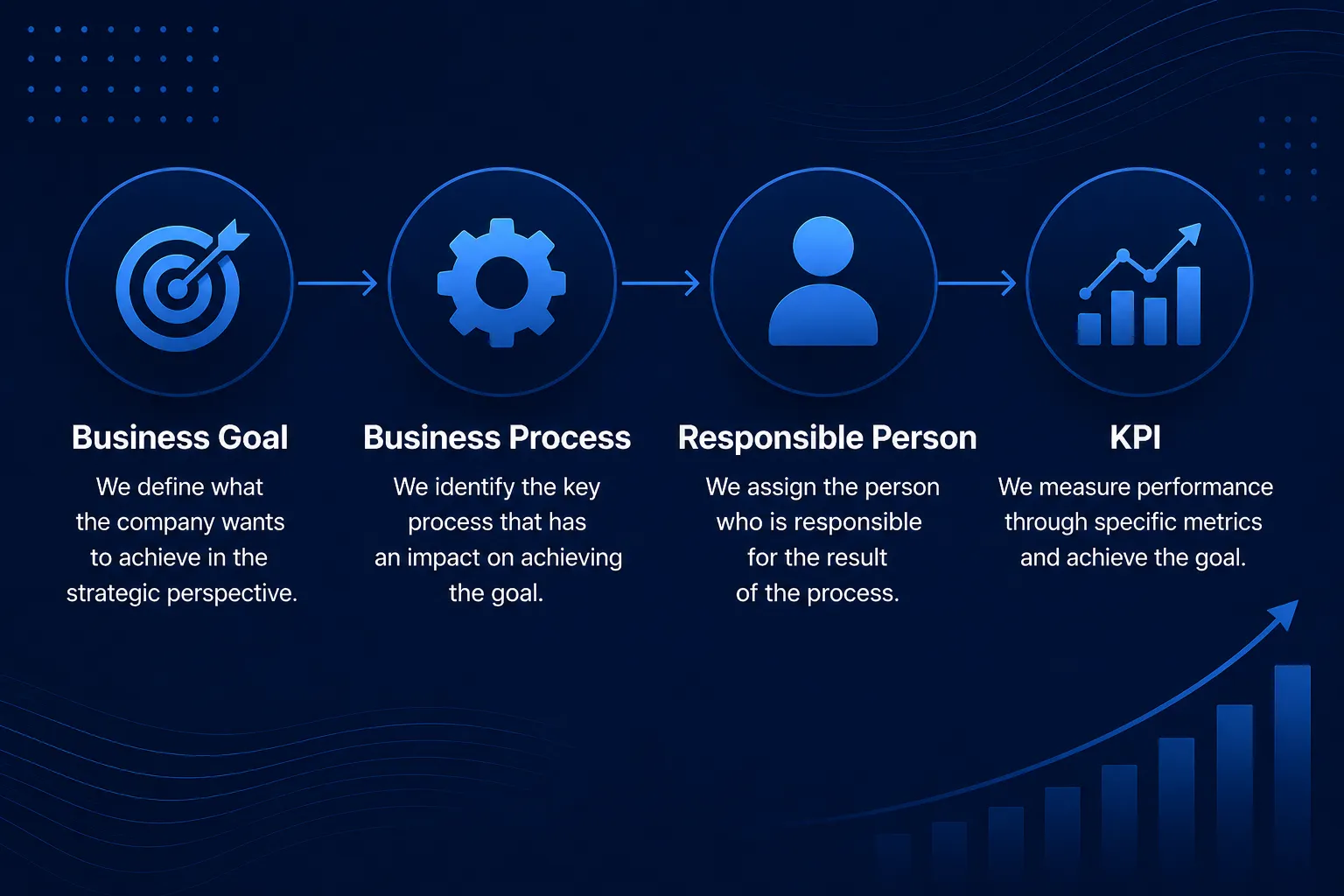
The biggest mistake business owners make is to define KPIs first and business goals afterward.
The correct sequence is always the opposite:
Business goal → business process → person responsible → KPI.
A bad KPI forces employees to meet a target. A good KPI helps the company achieve its goals. These are far from the same thing.
KPI achievement should be treated as an ongoing process of analysis and adaptation. Only then does the system provide real value. Understanding these principles is a key step toward success.
Before implementing KPI, answer just three questions:
- Which three indicators truly determine the success of my business?
- Which of them can I see every day?
- How much time does my team spend collecting this data?
If even one of these questions is difficult to answer, the KPI system most likely needs to be reviewed.
 ChatGPT
 Claude
 Perplexity